Monday, December 6, 2010

Week 2


Week 2 is when the magic really starts to happen. For starters we’re in Manang and the mountains are within touching distance. Our acclimatisation day is spent trekking up to the Ice Lake, a demanding 1,000m ascent to 4,500m - at that stage the highest I’d ever been. On our way we see some musk deer and Bhuwan constantly reminds me of the importance of trekking slowly at this altitude. On arrival the Ice Lake is nothing special but the views from its shore are easily the best of the trek. There’s a spastic beauty to the mountains from this vantage point, a sense that there’s a beauty overload and so what you’re looking at isn’t real at all. I’ve looked over some of my photos and this feeling remains - they somehow look like paintings to me, not at all of the physical world. It’s a special moment and a highlight of the trek. Of course a 1,000m ascent means a 1,000m descent and it’s a painfully boring slog alleviated only by the beauty in front of us. By the time we reach the base of the climb my eyes may love me but my knees despise me.
We overnight at Yak Kharka on our way to Thorung High Camp and we’re due to cross the Pass on Day 10. By now the Pass has become ‘THE PASS‘, and, collectively, it’s talked about with the same irrational fear as ancient sailors discussing possible encounters with monsters at the edge of the world. At Yak Kharka, whether it’s real or not, I develop a headache which disappears overnight, but I’d be lying if it didn’t leave me slightly paranoid especially with a night at High Camp to come. The perceived wisdom is that it’s better to overnight at Thorung Phedi rather than racing towards High Camp some 500m higher. Those who trek to High Camp for the night are looked upon with a mixture of sympathy and disdain. The trek to High Camp is laboriously slow but pretty easy, given the fact that we’re, quite literally, trekking at snail’s pace.
My night in High Camp is the longest of the entire trek. After an evening spent playing cards (very badly indeed) with Dave and Andrea - we retire to our 4 bed dorm which we share with Gyanendra, the friendly and flatulent sherpa who had been left without a room. From lights out at 9pm until our 4.30am start the next morning, I don’t sleep for a second and so I get to listen to every fart (of which there are many thanks to our sherpa friend), grunt, moan and groan. Trying to sleep is an exercise in futility and it’s a blessing when our flatulent friend turns the light on to begin the day of The Climb.
It’s ridiculously cold outside as we begin - but you’ll have that at 4,600m, right? - and the only thing on our minds for the first hour of the trek is the wait for the sun to rise. In spite of multiple layers, it’s painfully cold and progress is once again slooooowwwww……but when the sun eventually rises - the trekking equivalent of a 'watched pot' - and we see what’s in front of us the mood lightens (well mine does anyway). There are several false summits to cross before we finally reach our goal and, damn it, my arrival there is anti-climactic. I don’t feel any of the euphoria I’d expected, probably because I’m still too bloody cold and it’s way too fucking early to be that happy. The Pass itself is festooned with a multitude of prayer flags and there’s a sign congratulating you for reaching 5,416m. Remarkably there’s also a tea house which sells refreshments at prices that would make a Colombian coke baron blush and so I convince myself that I don’t need a milk tea in spite of the fact that all I want some 5,416m up is a milk tea. Bhuwan and I stand in beside the sign for the obligatory snapshots - just in case anyone ever doubts that I made it - and then we’re off again.
As we descend in the direction of Muktinath - a 1,600m descent - I’m suddenly struck by a headache of migraine intensity. Now whether it’s AMS or a result of the biting winds which greet us once we cross the Pass I don’t know but I accelerate my descent just in case. By the time we reach Muktinath it’s gone and so it’s forgotten about. After 10 days of trekking my lips feel as if I’ve been French-kissing a Brillo pad and so Muktinath is a welcome haven for our weary bodies and ultra-chapped lips.

Friday, November 26, 2010

Annapurna Circuit: Week 1


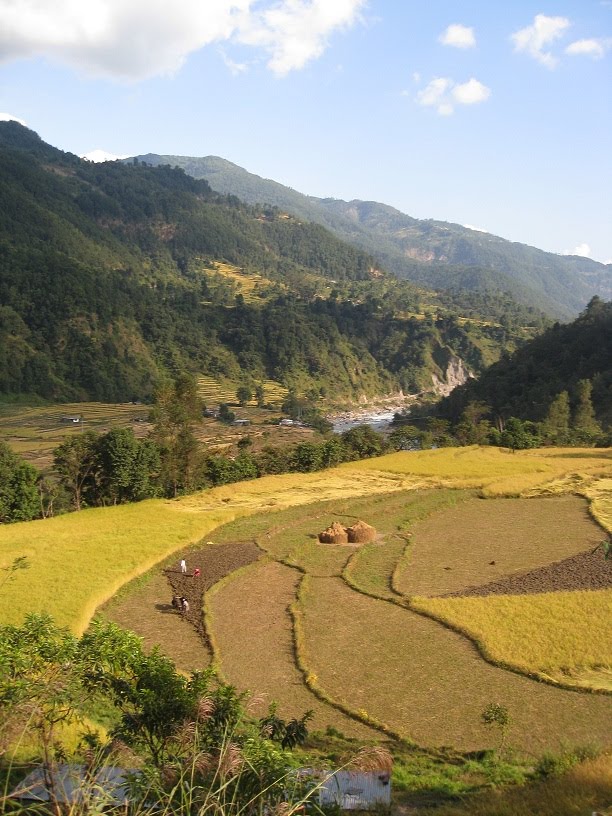
I should preface all of these trekking entries by stating that I had fully expected the trek to be physical carnage, for my feet in particular. I had pretty much assumed it would be a new blister every two days at least and so I was armed with enough Compeeds for twenty feet. Day 1 took us from Besi Sahar to the village of Ngadi, about 2 and a half hours away. From the outset the views were immaculate. The trek entered a valley which followed the route of the Marsyagandi river almost all the way to the pass at Thorung La and on our first days we trekked with views of rolling hills and innumerable stunning rice terraces.
October and November are the peak trekking months and it's easy to see why - the weather, in trekking terms, is immaculate. Temperatures peak at around 20 degrees so that it's warm but never hot and there's almost no chance of rain. Perfect. Nepal certainly knows how to have a winter. Bhuwan has fixed the itinerary so that we have a mixture of short days and longer days but on no occasion are we trekking for more than 6 hours. Very quickly it becomes apparent why this trek is so widely regarded. There's the views to start with which change ever so slightly over the first week. The rice terraces and rolling hills gradually give way to a slightly more barren yet no less spectacular mountain views.
The lodges we stay in are pretty standard traditional homes which have been altered to cater to the hordes of trekkers in peak season and there are a lot of trekkers on the trail in late October. The standard of the rooms varies little from lodge to lodge so as a solo trekker your room will be a rudimentary wooden space containing a bed, a light switch and you. Blankets you’ll have to ask for and you will definitely need them as night-time temperatures plummet this high in the hills. Many of the lodges have solar powered showers and so you need to get to your lodge early or pong the joint out for the rest of the evening. The closer you get to the Pass, instead of a shower you can buy a bucket of hot water to do the needful.
What’s most surprising about the first week of the trek is the average age of the trekkers. I’d imagined, given the nature of the trek, that it’d be filled with folk around my own age but the average age is easily over 50 and this is mostly down to the fact that many of the over 50’s trek in groups which can be a complete pain in the arse on the trail especially, for example, if you get stuck on a narrow stretch behind a group of French trekkers, none of whom will move out of your way. This was a common occurrence and as you eventually passed them by, you’d be greeted with a series of haughty comments, all en Francais of course. French trekkers do not understand the concept of giving way.
As the first week passed, an element of frustration began to creep in that our days were that bit shorter than I’d anticipated. Each morning we’d begin between 7 and 8am, trek for 3 or 4 hours so that by the time it came to lunch, we were done for the day. This meant arriving in a village around noon leaving a long, generally cold evening ahead. That’s said many of the villages were quite stunning and rewarded further exploration whether that meant a chat with some of the locals or a visit to the village monastery.
As the week progressed a trekking routine was established which involved an early breakfast, 4 or 5 hours of trekking, lunch and hot shower (or bucket) at the lodge, hang out the day’s saturated trekking gear and change into something dry and warm and while away the evening until dinner reading a book, exploring the village or chatting to fellow trekkers. And it is a very sociable trek - by the second or third day you see the same faces arrive at the lodges and the evening is spent bitching and moaning about the French trekking groups. Or perhaps that was just me.
My trek coincides with the celebration of the Dashain festival - a 15 day orgy of indolence, to my eyes at least. Not meaning to be cynical at all but there’s little doubt that this festival was first conceived of by a man. The celebrations drag on arbitrarily over several days and seemingly involve little more than the men of the villages gathering together to drink, gamble and, as a bonus, each sister is obliged to give her brother(s) a gift. Now that’s a proper festival and, as you could imagine, it’s celebrated with real gusto. It also seems to last indefinitely which is no bad thing if you’re a Nepali male.
Finally by Day 4 there are views of the Annapurnan peaks which reveal themselves finally on our trek to the beautiful village of Chame as we see both Lamjung Himal (6,986m) and Annapurna II (7,937M) in the distance. Best village of the first week though is Upper Pisang - a stunning collection of Tibetan flat roofed brick houses perched precariously atop a hill which towers over Lower Pisang. And if the village itself wasn’t beautiful enough then the view it offers of the mountains is pretty remarkable. There’s also a monastery above Upper Pisang at which we witness some monks play their wonderfully tuneless music whilst chanting their unintelligible prayers. Upper Pisang also stands out in my memory because of the 7 year old who ran riot through our lodge on the day we were there. A definite ADD candidate, his antics reached their peak when he entered the dining room in the evening, carrying in his hand a huge bag of weed (which thrives at this altitude) and which he offered to everyone in the room shouting (this kid had one tone only) one of his few coherent English words ‘GANJ?’ Upper Pisang’s future Al Capone for sure.
The only difficult day of the first week comes as we trek from Upper Pisang to Manang - we head off on a long, winding trail with switchback after switchback but the pain of the first two hours is eased by the fact that by the time we reach Manang in the afternoon we are right in the heart of Annapurna country and the full beauty of the mountain range is laid before us. And it really is an astonishing collection of peaks. The weather remained perfect each day - cold mornings followed by cloudless, sunny skies and warm mid-morning temperatures - which afforded us unbeatable views. Manang is 3,500m up and it’s commonly accepted that you’ll need to spend an extra day at Manang in order to acclimatise and avoid any trouble with AMS as you ascend further. Which brings me neatly to my next post…….

Heading for the hills


Now if I was one to believe in omens or the whispers of fate then I probably would have decided against beginning the trek as it seemed as if the fates were conspiring against me ever setting off at all. First off there was the ear infection which laid me low for a week and next it was the unexpected 2 day stop off in Bhuwan's home village of Turture. The plan was the spend a night there so that Bhuwan could catch up with his family and then we'd head off and hit the trail bright and early the next morning. This was something I was initially very happy to go along with as it gave me a rare chance to peek beneath the veneer of Nepalese society. It took two bus rides to get there on two chaotically overcrowded buses - this is the norm in all means of Nepalese transport - and we had one stopover to enjoy some buffalo momos and change buses at Dumre, a place where I also enjoyed watching a fist fight between two Nepalese youths.
Communication in Bhuwan's house was an issue as apart from Bhuwan, only his Dad spoke a smattering of English but, happy in the knowledge that we'd be there for one night only, I was content to ride out the interminable silences that come with language barriers. Besides the family were unfailingly polite and friendly so the awkwardness was felt on my part only. Nepalese males eat daal bhaat twice a day for their entire lives. No matter where they are, no matter what they're doing, lunch and dinner will always be daal bhaat. It's remarkable then that Bhuwan sincerely professes to still love the stuff. Our first meal there is of course daal bhaat and as I'm living with the locals I eat like the locals and tuck into the daal bhaat with my bare hands - no cutlery required. And it's not as easy as you might think. Daal bhaat contains rice which is smothered with lentil soup and then there are the sides of pickles, meat (if you're lucky) and spinach. The food is mixed together and you scoop it up with your right hand - always the right hand as the left hand is used for wiping one's arse and other such unmentionables - and eat. I watched the experts nervously before I tried, trying to give off the air of a man who's eaten several meals like this (do sandwiches count?) and scooped, slopped and swallowed.
The following morning it became clear that we weren't actually hitting the trail that day. Bhuwan's Dad reassured me that we'd be starting tomorrow - a Tuesday - which as he explained to me "Tuesday is lucky day in Nepal." Lucky for some maybe but not if you've been itching to hit the trail for some 10 fucking days. And so we duly spent the day in the village again - not the worst thing in the world by any means - and enjoyed the best of Bhuwan's family's wonderful hospitality.
Tuesday morning arrived and we waited for the bus to take us to the head of the trail at the village of Besi Sahar. Our bus had no room inside but this is Nepal and if there's one thing the Nepalese do well it's space management so up we climbed aboard the roof of the bus and off we went. I hadn't travelled like this since sitting in my father's boat years ago as he brought it to Lough Conn in time for another fishing season of big fish who got away. Eventually there was space for us inside - though I use the word space in the loosest sense - and I sat in the front of the bus with the driver ramming the gear stick into my knee with no little relish on every gear change. Exactly what every trekker wants before a 3 week trek.
About half an hour from Besi Sahar, the final obstacle to our trek emerged most unexpectedly. A motorcyclist, upon seeing our bus, decided that now would be a good time to lose control of his bike and damn well nearly slide right underneath us. Fortunately he stopped before going under and only because our bus had reached the crest of a hill or perhaps my patella saved him. The driver was fine but his passenger cut his knee pretty badly and was none too happy with his pilot. And so finally we reached Besi Sahar.....

Friday, November 19, 2010

And now the end is here

Sitting in a hotel room in Pokhara typing these words at the end of 18 days trekking, listening to This Is Just A Modern Rock Song whilst two Nepalis try to outdo each other at cards in the foyer of my hotel for the night. Will attempt to put into words what was the most incredible trekking experience of a lifetime over the coming days. The people, the villages, the mountains, fucking hell the mountains, the fact that whenever we needed clear skies, the clear skies appeared....every single little detail of what's happened in the past two and a half weeks. Anyway, draining a beer now and listening to some tunes - two pleasures I've deprived myself of these past 2 weeks...more to follow. Heady times. Roy Hodgson's still in charge? What the fuck?

Saturday, October 30, 2010

The Annapurna Circuit

So tomorrow I’ll finally begin the Annapurna circuit trek with my guide, Bhuwan. The AC trek is world-renowned and rightly so - it stretches over 300km around the Annapurna range, the highest of which - Annapurna I - reaches over 8091 metres. Put Croagh Patrick on top and you have a mountain almost the same height as Mount Everest. The trek takes anything from 16 - 21 days to complete, depending on your pace, fitness levels, which side-trips you choose to do and how you fare with the acclimatisation. And that’s the main problem with the Annapurna trek - it begins at an elevation of 800m and approximately 10 days later, you should be crossing over Thorung La at an altitude of 5,416m, which is about as high as you can get without specialist mountaineering equipment. Perhaps up there I’ll question the wisdom of splurging on sub-standard North Face gear but I’ve purchased enough of it to ensure that I’ll stay warm at least. Somehow I’ve also managed to get a credit note for my jacket, so confident was my seller of its quality.
It’s quite a climb and acclimatisation is essential in order to ensure that you return in one piece. Once you go above 4,000m there’s an increased risk of AMS (Acute Mountain Sickness) - the body is just not used to being at such a height hence the need to stay at a certain height in order to enable the body to adjust to being at this altitude. At that height it’s like a pair of invisible hands pushing you down. I’m in very safe hands though as Bhuwan is a veteran of this and many similar treks in the Annapurna region. Your susceptibility to AMS varies for each individual (in the same way folk can handle their beer I guess) but the good thing about it is that if you feel ill - headaches, nausea etc - there’s a simple cure, as long as you take immediate action upon noticing those symptoms, which is to descend to an altitude where your body feels more comfortable and the symptoms should disappear once more. It’s also recommended that you don’t gain more than 300m in one day once you’ve reached a certain altitude.
A guide is not essential on this trek but here are many reasons I’m bringing one; he’ll provide company and hopefully give a detailed insight to the villagers’ way of the life as we trek, it’ll be good to have someone there if sickness strikes and, best of all, you’re contributing to the local economy by giving someone a job for 2-3 weeks. Porters can also be employed to carry your gear if necessary but as my pack weighs about 7 - 8kg, I’ll bear my own burden.
This trek is the very reason I came to this part of the world in the first place. Were it not for the AC, I would probably have gone straight to West Africa or South America somewhere - but that can wait for now. This is the peak season for trekking here and the weather is ideal during October and November. It hasn’t rained once since I arrived in Nepal which is quite a contrast to the downpours which blighted the end of my time in southern Vietnam and all of Cambodia. Temperatures regularly climb above 20 degrees but nights in the mountains are cold, which won’t concern me as long as it’s dry.
The AC is a teahouse trek and so at the end of a gruelling day’s hiking you can at least look forward to a bed in a lodge, some hot food and the possibility of a hot shower. Lodge prices are pretty standardised but naturally the rates climb as you climb and so it is with the food. The fact that this is peak season however means that the slopes will be busy and lodges will be in great demand so it might mean an extra wait for the daal bhaat at the end of the trek. Daal bhaat is the classic AC meal - it’s a combination of rice with lentil soup poured over it and served with a potato or vegetable curry on the side. So I’ve signed up for 20 days of that! Food on this trek is a mish-mash of the following four staples - potatoes, rice, noodles and pasta. Trekkers do not choose this route for the culinary experience.
Bhuwan has written up an itinerary which involves a couple of side-treks in order to assist with acclimatisation and also as a means of adding further to the AC experience. Most alluring of all for me though is the fact that I get to shut myself off completely from the outside world for the next 3 weeks. Roy Hodgson gets sacked? Good, but I‘ll think about it when I‘m done trekking. Brian Cowen develops a smack habit? Couldn’t give a shit. Ireland is forced to undergo shock treatment at the hands of the IMF? As long as I have enough money for my daal bhaat, it doesn‘t concern me for 3 weeks at least. No phone, no computer, just me, Bhuwan, my backpack and the mountains all around me. Now what could be more beautiful? This is where the magic happens.

To Pokhara


Right then, the mountains are calling and so I hop onto a bus which, I’m told, will take 7 hours to get me to Pokhara which lies in the shadow of the Himalaya. It costs 400 rupees to get there (€4 - the Nepalese rupee is a wonderfully agreeable currency in that €1 = 100 rupees) and my bus is a pretty beaten up 20 seater which is, mercifully, only half full. It has air-con also but only if you open the windows all the way. Very quickly it becomes apparent that we’re going nowhere fast and, just outside of the city, we enter into a valley which descends via a series of seemingly never-ending bends far, far below us. The road there however is clogged with traffic and we spend that long navigating our way down that the driver turns the engine off each time we stop, as each delay is 5 minutes at least. It all means that after 3 hours of travelling we’ve advanced roughly 30km out of the city. And, yes, the mathematicians out there will by now have worked out that that’s a ridiculous 10km per hour. The open windows mean that after an hour’s travel we’re all covered by a thick film of dust and shit.
Once we’re finally at the bottom of the valley, the road opens up - but doesn’t widen - and we’re back approaching acceptable speed levels again. The journey ultimately takes 8 hours and in the last hour we’re rewarded by glimpses of the towering snow-capped peaks of the stunningly impressive Macchapucchre (6997m) and Mardi Himal (5553m) which pales somewhat in comparison to its neighbouring peak, both of which lie north of the town of Pokhara and deep in the Annapurna sanctuary area.
I quickly find lodging close to the lakeside - a pristine, freshly painted guesthouse far away from the madding crowd for just over €5, and with unlimited hot water (not as common as you might think) it’s exactly what my grime covered body needs. Here I’ll spend the next two days making sure I have all of the equipment I need before setting off on the Annapurna Circuit trek; the sole reason I have come to this part of the world in the first place. There’s a plethora of Tibetan restaurants all around Pokhara - Tibet is just a hop, skip and a jump over the hills after all - and desperate to try out some genuine Tibetan fare I order what the waiter assures me are buffalo spring rolls. The Tibetan name for what I’ve ordered is buffalo Sha Bhack Ley (I had to write it down) and in the half hour it takes for them to arrive I’ve gulped down two cups of beautiful milk tea, but the wait is worth it. I’m served two huge, what could be best described as pasties fresh from the oven. They’re sublime, the pastry still flaking from the oven and the buffalo baked with garlic, onion and spices. I immediately order two more because I need fattening up before this trek, and besides, the prospect of 18 days of menus filled with 4 varieties of daal bhaat looms ominously on the horizon.

Wednesday, October 27, 2010

Kathmandu Part II


There are certain places in the world that you wouldn't wish sickness on anyone and Kathmandu would probably be high on that list. Alas, my luck was out upon my arrival here - the ear infection I'd feared ever since my days diving in Thailand emerged within hours of my return to Bangkok and, as luck would have it, I had not one, but two flights to take the following day, first to Delhi and then on to Kathmandu. Groggy as hell upon arrival here and with little or no hearing in my left ear, I checked into my lodgings and headed straight to the Nepal International Clinic. The place deservedly has an international reputation and many thanks to Dr. Shresta who patiently listened to me moan about not being able to trek whilst doling out medical advice and ear drops with a proper kick. Two more days of almost complete deafness in one ear ensued - it's no fun travelling alone in those situations - but by Day 3 things began to clear up and get back to normal.
Most of the magic happens well outside of the confines of Thamel which is designed solely with tourist interests in mind. Firstly, there’s the magnificence of Durbar Square, a stunning complex once home to the Nepali royal family and filled with temples, roaming livestock and the ubiquitous pigeons. I'd almost forgotten how much I fucking hate pigeons. The square is also home to the Kumari. The Kumari, the Nepali Buddhists believe, is the modern-day manifestation of a goddess and the process to choose a kumari is a rigorous one as the child - and it's always a child - is chosen from a particular clan and must pass a variety of eligibility tests e.g. never shed any blood, lost any teeth etc. Once the child reaches puberty and begins to menstruate, they're discarded (the shedding of blood is seen as impure) and the whole process begins anew to find the next kumari. As it was all described to me, I couldn't help think of Bill Cullen, pointing a withering finger at an unsuspecting 15 year old, mouthing the words 'You're fired'. The Apprentice: Kumari.
Streaming through the square is an endless stream of porters carrying back-breaking loads with a solitary strap attached to their foreheads. They quietly shuffle along, barely able to see in front of them bearing loads as diverse as computers to plastic chairs piled 20 high.
Then there’s the sight of the sadhus - truly remarkable looking men in brightly coloured robes and psychedelic face-paint who unfortunately stand there with the sole intent of encouraging tourists to take photographs of them in return for having their palms greased. One approaches me with the familiar call of ‘Namaste’ (Nam-ass-tay), makes a take photo gesture and immediately stands to attention complete with crazy face and finger pointing skyward. I smile, shake my head and walk away. It's surprising given that the sadhu has given up all material belongings in order to achieve freedom through meditation. But these are 21st century sadhus and this is a recession, right? Or maybe they've always been like that.
From there it’s a long hike out to Pashupatinath which is the holiest Hindu site in the city. Through this site flows the Bagmati river which, I’m told, flows all the way to the mighty Ganges. There's a rule here - which isn't all that strictly enforced - that all non-Hindus must stay on one side of the river and view the temple from there. But, for me, Pashupatinath's main draw card are the Hindu cremation ceremonies which occur there. As I sit on the other side of the river it’s clear that a ceremony is about to occur and so I sit and wait, the voyeur in me fascinated by something I’ve never witnessed before and something I thought I’d have to wait till I got to Varanasi to behold. There’s a group of about 8 Hindi women, resplendent in their brightly coloured saris, crouched over a white blanket upon the ground. Soon it becomes clear that this is the corpse and the sheet is peeled away as the ritualised washing of the corpse begins.
I should point out that I’m not the only one fascinated by this ceremony unfolding - there’s a crowd of about 50 others glued to what‘s happening. Once the corpse is washed, it’s then wrapped initially in an orange robe and then finally in a pristine white robe. Along the filthy river there are about 8 ghats or podiums upon which a pyre is built. The corpse is then placed upon the pyre, lit and burns for as long as it takes. Once the fire dies down, the ashes are swept into the river. The reason the bodies are cremated like this is the belief that the body is a combination of 5 basic elements. When a person dies, the fire ceases so fire is used to complete the fifth element. Or something like that. As it happens, having sat for an hour, nothing happens. The corpse, now wrapped in robes is unceremoniously left there and so I continue on my way investigating the rest of the temple.

Tuesday, October 26, 2010

Kathmandu Part I


And so on to Nepal and Kathmandu - the power cut capital of the world. And it’s bloody great to be here! Arrived via Delhi - kudos to Delhi airport for having limitless recliners for in-transit passengers on 7 hour layovers. I’m hoping that the city will be as kind to me upon my return some 2 months hence. So I find myself in Thamel in a guesthouse that looks a hell of a lot better on its website than in reality but it’s done me whilst I’ve slept off the flight. Will go in search of pastures greener in a couple of days. So, what to say about Kathmandu?
Remember that scene in Great Expectations when Pip rips the curtains down from Miss Havisham’s dining room to reveal a room covered in decades of dust? Well that’s Kathmandu. One big, filthy and neglected urban sprawl but absolutely wonderful because of it. Random Kathmandu events on my first day here include the sight of a monkey, either unobserved or ignored by everyone, clambering along the power lines on the main street in Thamel and the fact that what adds to the traffic congestion in this city are the random cows who roam the streets in search of pasture. Bizarre.
You can measure a city’s grittiness by the behaviour of its rat population and on that basis Kathmandu is hard. Kathmandu’s rats own the fucking joint - and daring daylight breaks through Thamel’s streets are all in a day’s work for them, sending scores of tourists jumping and screaming as they scurry past.
The city is a warren of the narrowest streets - I think that nominally there’s a one-way system in place but nobody cares as one, two, three and four-wheeled vehicles fight for the right of way. If you happen to be in the way, you’ll know. This vehicular backlog leads to the worst pollution imaginable, so bad that even the drivers wear masks. What Trabants are to Eastern European streets so shitty ‘70s Toyotas and even shittier ‘80s Suzukis are to Kathmandu's clogged routes, each of them emitting Yeti-sized carbon footprints.
Naturally everyone’s here for the mountains so if it’s knock-off North Face gear you want, then literally every second store is here to cater to your needs. Today, for example, I decided to go around and haggle hard for some rip-off gear and it’s amazing how the prices drop. Nobody denies in the slightest that what you’re buying is not really The North Face gear but, you’re assured, it’s the highest quality fake North Face gear available in Kathmandu. Today’s quest for a waterproof, windproof and warm jacket which would do me crossing the Thorung La pass saw me try 12 different shops, receiving quotes ranging from 9,000 Rp to 3,500 Rp for the exact same jacket. It’s hard not to be lulled by the prices when the gear you hold in your hands looks exactly like the real thing but 3 weeks in the mountains will test the folly or otherwise of my largesse.

Saturday, October 16, 2010

The Japanese tourist

I love Japanese tourists. I think everyone loves Japanese tourists really. Except, perhaps, the Chinese. Or the North Koreans. But let’s park that for now. Having visited Angkor Wat over the course of a few days - one of the many 8th wonders of the world - and as with all of the truly magnificent man-made and natural sights scattered around the four corners of the globe, the Japanese tourists were there in force. And what a force they are. I love Japanese tourists for many reasons including their unfailing politeness (unless of course you’re in their way for that ‘money shot’ as the sun descends over the Grand Canyon, say), their general cheeriness and their sense of wonder - listening to their ‘ooohs’ and ‘ahhhs’ as the history of a place is being described to them.
Where the Japanese tourist goes, the most up-to-date technology always follows which generally means a preponderance of telescopic lenses which generally stretch to, never mind zoom to, 200 metres. Yes, wherever you’ve been or whatever you’ve seen the Japanese tourist has been there and seen it before you and has the photos to prove it. In fact, today got me a thinking as I cycled from one wat to the next - Japanese tourists have been at whatever major sight I’ve visited since I began travelling. My theory is that they’ve been there snapping away at the different wonders of the world for many, many years. But here’s where it gets weird - maybe they’ve always been there snapping away down through the mists of time. Who’s to say that when Angkor Wat was constructed back in the 12th century that there wasn’t a gaggle (the collective noun for Japanese tourists has to be ’gaggle’, or, perhaps, a ’click’?) of Japanese tourists there, zooming in on the workers as they toiled underneath the sun, politely elbowing each other out of the way in order to achieve the perfect shot.
Who’s to say they weren’t there at Giza when the pyramids were constructed? Confusion as to how the pyramids were constructed? Just ask the Japanese for their negatives. That’ll clear it up. My mind raced through history - imagine Bethlehem on December 24th, Mary in the throes of labour pains, her hand clutched by Joseph, the baby about to appear when, suddenly, up pop two Japanese tourists behind the manger flicking peace signs at the camera whilst simultaneously oohing and aahing at the end product of an immaculate conception.
Or take it further back. Shit, the Japanese tourist could prove for once and for all whether or not God does exist and in the process save us another book by Richard Dawkins. I’ll bet they were there on the 7th day snapping away wondering why God was only working a 6 day week.

Cambodia vs Thailand


The photos above were taken at Bayon, mentioned in the previous post. Wonderfully bizarre place. So I’m still here at Angkor Wat - well, about 5km away in the city of Siem Reap - and as part of being here I wanted to do a little research into the entire site to make sure that I knew exactly what it was that I was looking at. The Cambodians are fiercely proud of Angkor Wat - it is on their national flag after all - and naturally it’s seen as the jewel in the Cambodian crown. And rightly so. However, relations with next-door neighbours Thailand have not always been the most amicable, let’s say, and as recently as 2003 the two countries were at loggerheads once more over a dispute as to which country should actually lay claim to Angkor Wat. The Cambodians went berserk at the suggestion that Angkor Wat actually belonged to Thailand of all places. Things got nasty pretty quickly and it got to the stage where Thailand had to evacuate 500 nationals after anti-Thai riots left one dead and seven injured, most of them Cambodian.
And the source of these ill-conceived comments? The King of Thailand? The Foreign Minister? Nope - Suvanant Kongying, a Thai soap actress. Which kind of beggars belief really. In the long and tempestuous history of Anglo-Irish relations you couldn't imagine tensions growing because Bella from Fair City let slip in an interview that he felt that London Bridge technically belonged to Ireland. Would anybody even pretend to notice? I think not but it goes to show the tenuous relationship between both Cambodia and Thailand and the idiocy of giving credence to comments from soap stars.

Angkor Wat


So let me paint the picture - it’s 9.06pm on a Friday evening and I’m sat here in my guest house room and, basically, I’m stranded. It is leathering it down outside and has been doing so for the past 6 hours. In fact it has been doing so in Cambodia as a whole on and off for a week, so much so that much of the country is underwater. Siem Reap, where I presently reside - is partially underwater thanks to the river which has burst its banks. Truly I’ve never seen rain like this and even the locals are scratching their heads. So I popped out earlier to the local supermarket - a 5 minute stroll normally but wearing flip flops in these conditions, a gruelling 15 minute ordeal - to stock up for the night i.e. some chocolate and three cans of wonderful Singha beer (which have made me all nostalgic for Thailand again) - only 65c each! There’s the thing about Cambodia - since I entered this country 4 days (or is it 5?) ago, I haven’t conducted one transaction in the local currency. Everything is done through dollars and I have yet to find an ATM which will dispense anything but dollars.
Blessed as I have been on this trip, yesterday was my first full day here and for those who don’t know, Siem Reap is the gateway to Angkor Wat - quite the most sublime historical site you’ll find in all of SE Asia.I know that I've become temple tired at this stage but this isn't just any wat, this is Angkor Wat! Anyway, getting back to luck, it didn’t rain at all yesterday which enabled me to complete the Grand Circuit around the temples of Angkor, seeing all of the heavy-hitters and a few more besides without getting pissed on. Which was nice.
I rented myself a bike for 2 dollars which was one of those old bone-shakers your Mum used to cycle back in the day, a gear free contraption that somehow took me around for my day's touring.
As a kid, whenever I ate dinner, apparently I used to hoard whatever my favourite part of that dinner was until last. So if SE Asia is my dinner then Angkor Wat is my chicken nuggets. Sort of. Genuinely I had deliberately planned my circuit of SE Asia in order to save Angkor Wat till last and it hasn’t disappointed. Well, except initially it did. You see as I cycled along I felt a sense of anticipation that I hadn’t felt since I visited Petra a few years back and as I rounded the corner on my bike and the temple slowly emerged, it did feel pretty special until you looked closer and saw that they’ve got the builders in and there’s that horrible green scaffolding right out front. But once you get into the grounds and look at things up close - it really is a magical place, scaffolding or not.
North of AW is Angkor Thom which is another series of magnificent temples. First up was Bayon which looked like, well let’s see - you know that episode of The Simpsons when Homer is tripping on LSD, well that’s what it reminded me of. Or ‘I Am The Walrus’ by The Beatles. Or if you gave a child a ton of Lego and asked him/her to assemble it in the dark then Bayon is what you'd end up with. It’s a temple unlike any temple I’ve ever seen and it is quite the most wonderful sight. Strange things pop up around every corner and there are gigantic faces leering at you no matter which way you turn. Fantastic place.
Beside that is the less spectacular but equally puzzling Baphuon. Alas Baphuon was not only covered in scaffolding, there was a team of builders reconstructing the roof on the bloody place and so was unrecognisable. You know that opening scene in ‘Lost In Translation’? Well, if you replaced Scarlett Johansson’s thighs with Betty’s from Coronation Street - that’s what visiting Baphuon felt like. Yes, it's mad analogy day today.
My guesthouse is the only consolation I can cling to today as the rain continues to sheet down outside. Thanks to the free wi-fi in my room I’ve been able to keep abreast of the Liverpool ownership saga - and what a fucking soap-opera that’s turned out to be! But my guesthouse has got to be the first place I’ve ever stayed in which offers ‘Free Ride To Church Services’ as part of their promotion. If this rain continues hopefully they’ll use their contacts to put me on an Ark to get out of Cambodia and back to Bangkok.

Wednesday, October 13, 2010

Into Cambodia and frogs

New country! Two weeks in Vietnam - wonderful place, almost certainly not long enough there but there’s something consistently invigorating about entering a new country. I’ll only be in Cambodia as long as it takes me to wander around the temples at Angkor Wat and a brief visit to Phnom Penh but it’s good to be here. My first 3 hours in Cambodia will not quickly be forgotten as I was subject to an horrific ordeal of karaoke terrorism of the worst kind. Now we’re all familiar with stories of US forces playing Megadeth and Motorhead at extreme volumes to Taliban prisoners in order to extract confessions (surely three minutes of this would have worked), well by the time I walked off the bus I was ready to confess to a litany of crimes including being the brainchild behind the Khmer Rouge, Al-Qaeda and that yes, yes, it was me on that grassy knoll after all.
My first impression of Phnom Penh - surely the most cantankerously named city in the world - as I climbed off the bus was that the entire city smells like a musty hotel room. Reeks of it. Having survived the scrum of moto drivers waiting to manhandle me and others to their various hotels, I strolled through what I assumed was the rougher part of the city. 10 minutes later I was still in the rougher part of the city when it dawned on me that this is what all of Phnom Penh looks like. That said if you stroll far enough to the river there's quite a nice promenade walk there.
Now I haven’t been all that gastronomically adventurous on this trip to date and so I decided to chance my arm a little here now that my South East Asian odyssey is drawing to a close. I passed through all of Vietnam without having tried - or having been given the chance to try - dog. Damn it, I love dogs, sure, but if I’m in a country and there’s dog on the menu, why not? But I never did get the opportunity and short of dragging one of the many mongrels in from the street, landing it on the table and demanding “Here, cook this,” the taste of dog will remain a thing of mystery to my palate for now.
And so now that I’m here in Cambodia, my best attempt at trying something unusual is, er, frog. Yes, it does sound rather apologetic, I’ll admit. I had a choice between large and small and so I ordered the small wondering briefly if this would mean I’d get tadpoles. There are a wide variety of ways in which you can have your frog served to you and mine arrived soused in ginger. Who would have thought that a frog had so many bones, because that’s pretty much all the taste I got from the bloody thing. Even if I was unsure that it was frog I was eating, my doubts were allayed as I munched my way through my meal, and one leg after another appeared as the ginger and other frog parts gradually disappeared. I just couldn’t bring myself to eat the legs - not out of disgust mind you - but I just couldn’t see any meat and so my plate was left with four little legs which I tried to arrange in a humorous way on my plate for a photo opportunity, but feeling the disapproving gaze of the waiting staff I abandoned the plan.

Vietnam in 2 weeks


Began my next Vietnamese leg by flying from Halong Bay down to Hue which, though I wasn’t aware of it at the time, helped me to avoid some of the worst flooding which has hit parts of north Vietnam hard. Apparently the bus ride from Hanoi to Hue which generally takes 12 hours is taking 24 hours now.
Hue is a pleasant city and famed for its citadel which takes up most of the northern part of the river. The citadel itself is dreary as hell though - easily its most impressive aspect is the wall which surrounds it. Between bombing and neglect the inside has all the charm of an empty Tesco car park albeit without the boyracers. On my second day in Hue I took a tour north to visit the DMZ (demilitarized zone) which marked the unofficial border between north and south Vietnam during the conflict. Interesting stuff which was finished off by a visit to the Vinh Moc tunnels where, remarkably, the locals lived for 6 years and where you‘d have to be of Tom Cruise dimensions not to develop a permanent stoop.
Next stop was Hoi An, a truly beautiful little town which reminded me of Luang Prabang in Laos. There is little else to do than ramble slowly through the streets there, soaking up the atmosphere and no better place to do it.
I had my first sleeper bus experience on the trip from Hoi An to Nha Trang and it’s something that should be tried once - but only once. Picture about 20-30 half-reclined beds spread three wide throughout the bus with barely enough room in between to squeeze through so, to paraphrase the song, if your arse is indeed the size of a small country, take the train. I finally found a berth at the back where the beds were five wide and where, if you have privacy issues, too fucking bad. You soon become accustomed to someone shoving their elbow in your neck just as they become accustomed to your flatulence. No one complains as it’s a 12 hour journey and it’s best to suffer these things in silence. It’s the sleeper bus way.
Nha Trang is quite possibly the ugliest and most banal place in this entire country. Jesus wept, it is monotony incarnate. Try as I might I cannot put forth any valid reason for the existence of Nha Trang but, inexplicably, the Russians love it - there are Russians everywhere here and consequently lots of see-through singlets and bleached blonde hair, and that’s just the guys. If you don’t dive here then - simply put - you’re fucked as far as I see it. In my 2 days in Nha Trang the sun didn’t shine once and so those who came solely for the beach must have felt very shortchanged indeed. Perhaps it was just me - a type of SE Asian weariness maybe - but everything in Nha Trang was shiteful, even the diving. Visibility was about 5 metres at best, and when you could see ahead there were a few sorry looking patches of reef scattered here and there. Even the fish looked fed up. No, nothing could have saved Nha Trang, not even if I’d seen a whale shark dry humping a blue whale.
I arrived in Saigon in the early morning hours having taken the hard seat overnight train to get there. Splintered and weary I wandered in search of a bed for the night. Little did I know that Mrs. Hu would be patrolling the streets looking for folk just like me - tired, grumpy looking, lost with Lonely Planet in hand wondering where the fuck I was - and she almost literally dragged me to her ‘home’. Strange, strange place - she made all sorts of claims for it on the street - free wi-fi, big breakfast etc etc - but none of them came to fruition and I was too tired to argue so I took the room. She pretty much told me that I’d be buying my ticket to Phnom Penh from her but I said nothing because all I wanted to do was sleep.
Saigon - evocative name or no - was, to my eyes, just another city. Took in a few sights, tried to drink in some of the atmosphere but it wasn’t really happening for me. The fact that there was a biblical downpour for about 10 hours on the only full day that I was there certainly didn't help. And then that evening as I wandered around trying to buy my ticket to Cambodia, there she was again, every time I turned around - Mrs. fucking Hu asking me what my plans were, where I was going to next and when I would be going there. I did buy my ticket to Phnom Penh but not from Mrs. Hu because if her rooms were anything to go by - oh and the light in the room didn‘t work either - I could quite conceivably end up to my neck in shit somewhere in the Mekong Delta. Balls to it, I’m just getting city weary at this stage. Vietnam is undoubtedly best enjoyed from south to north methinks. Bring on Cambodia.

Thursday, October 7, 2010

Halong Bay


Chasing my tail a little here in north Vietnam. Since arriving in Hanoi on the 29th Sept, I spent two days and one night there checking out the city. The following night I took my overnight sleeper to Sapa, followed by two days and one night there. My next night saw me take another overnight train back to Hanoi in order to join up with a tour to Halong Bay. The train arrived in to Hanoi at 5am and my tour was to leave at 8am. Generally I despise joining up with tours for a variety of reasons but in this case the end justifies the means as I have little time to play with. Besides, it all sounds very promising - the boat looks great on the brochure, the itinerary seems to fit in most of the highlights of Halong Bay and the price is just about right - $80 for two days one night. This includes a $15 single supplement - something I’ve come to refer to as the ‘gooseberry tax’. Single? Right, you sad bastard, that‘s extra.
Joining up with a tour means following a tour-guide, possibly the most hateful thing about travelling. A bus takes us from Hanoi to the boat and we all waddle after the tour guide, stopping where he stops, going left where…etc etc. Just like on school tour. The boat is indeed quite lovely and we’re all greeted on arrival with a hot towel and what both looks and tastes like Miwadi orange juice. Our first chat with our tour guide reveals - and tellingly he waited till we were on board to inform us - that the generator on the boat broke down the previous night. Last night’s guests - we’re unnecessarily informed - complained a lot. On arrival in my cabin there’s immediately a steady leak of water through the roof from upstairs, right down on top of one of the beds in my room. Fortunately there’s a second bed - the joys of the single supplement.
We visit a gigantic cave which they’ve ruined by inserting disco lights and, more bizarrely still, a fountain. It's a cave for fuck's sake. Over the course of our two days on the water it quickly becomes apparent that we are easily the slowest boat on the bay. In the course of the two days there our boat covers an area of one square mile repeatedly and all the while we are told that we are about to explore new parts of the bay soon. It never happens. The boat isn't broken either, we're told, it's just the water at this time of year. All extremely believable stuff.
The food is good, the people are lovely but ultimately the tour is an utter bag of shite - the cruise equivalent of being handed an ice-cream but only getting to lick the wrapper. I would have seen more of Halong Bay had I bought the 10 postcard package offered to me by one the many hawkers before we boarded our boat. But damn it, I’m loving Vietnam in spite of itself. Next stop Hue.

Monday, October 4, 2010

You buy from me?


To Sapa then, the second leg in a three part dash around north Vietnam. I took an overnight soft-sleeper coach (4 berths) from Hanoi to Lao Cai which is nestled snugly right next to the Chinese border. The real reason I, and many westerners venture this far north though, is to visit Sapa which is about 40km from Lao Cai where the bus drivers here will spill blood - but curiously not drop their prices - to herd you on to their minibus.
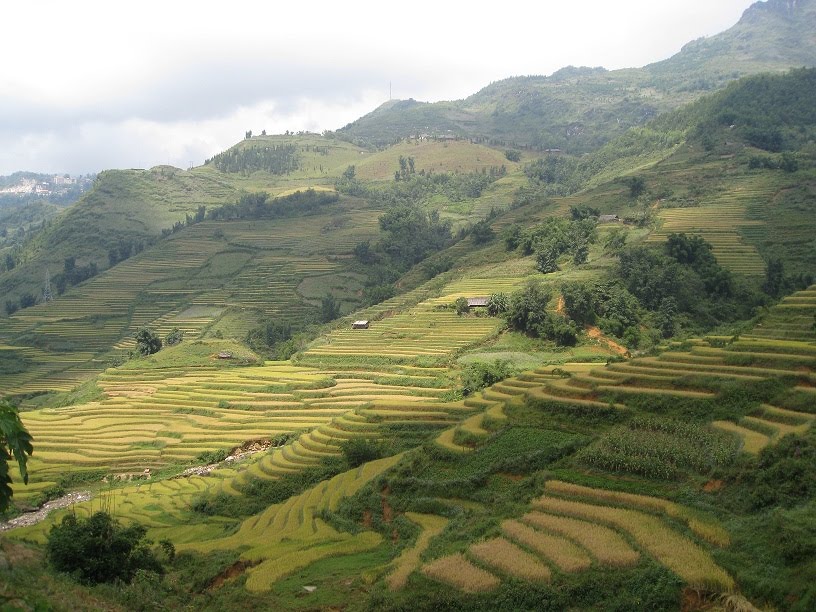
Sapa is found high in the hills of northwest Vietnam which, for one thing, means that, for the first time on this trip, pretty much, I felt cold by night. Though the town itself is pretty unspectacular, its setting is nothing of the sort. The draw for most folk here are the quite incredible rice terraces which surround the town, lending the whole place a weirdly unnatural feel, but it is truly spectacular. It’s hard to describe the terraces exactly but it lends a strangely neat and ordered look to the countryside - nature’s very own version of the IKEA effect.
The fact that it’s harvest time and that the natives are busy carrying out the back-breaking tasks they do as routine, regardless of the fact that a bunch of westerners are pointing their cameras at them or not, adds to the colour, sound and atmosphere of the area right now. Much of the work is being carried out by the various hill tribes who inhabit these fields - the H’mong being the most evident to me - and almost all of them still wear their traditional clothing. Those who don‘t work in the fields spend their day in downtown Sapa chasing and charming tourists - more of the former than the latter it seems to me - selling hand-made trinkets and greeting everyone with the cry “You buy from me?”
I managed to take in a short hike through the terraces and through some of the traditional villages where the H’mong people who inhabit them are, by now, conditioned to the peering eyes and the clicking cameras of passing strangers. Stunning place.

Saturday, October 2, 2010

Happy Birthday Hanoi

Next stop Hanoi. This ancient city is 1,000 years old this year and the fact is being celebrated, seemingly on a daily basis. There’s celebratory bunting on every street and Vietnamese flags hung from every shop front. I’m still struggling with some of the more rudimentary Vietnamese phrases but I know exactly how to say ‘Happy Birthday’ for all the fucking good that’ll do me if I‘m lost and hungry somewhere in the Mekong Delta.
The festivities are centred around Hoan Kiem lake which lies in the middle of the old quarter where you’ll find most of the hostels, restaurants, bars and, indeed, life in this city. It’s a wonderfully mazy neighbourhood where maps are for pedants only as there’s zero chance of getting really lost with such a huge bloody lake as a reference.
Hanoi is home to a well trained school of motorcycling mujahideen who dare you to enter into a battle of wills with them. Simply put, crossing the road in Hanoi is unlike anything in any city I’ve experienced before, and I’ve been to bloody Cairo. The traffic never pauses from any direction, the pedestrian crossings are there for effect only and the green man you see inviting you to cross the road is the Hanoiese equivalent of an invitation to a chicken-run.
I’m staying in a hotel in the old quarter that, if it were any rougher around the edges, they’d be handing out knuckle-dusters as you checked in. But it has a bed, is perfectly central and has a functional shower - these are the bare necessities on this trip. Sleeping and showering - this is what keeps me going in Asia.
Hanoi is also home to the cheapest beer of this trip. Earlier today I sat on a tiny plastic seat sipping cans of ‘Bia Ha Noi’ for 11,000 dong which is less than 50c, almost enough to make me complain about the price of beer in Prague. Because of this it would of course be rude to drink just the one. Hic.
This is also the base for my trip north to Sapa and then on my return a swift hop over to check out the much vaunted delights of Halong Bay. But here’s where things get interesting. Vietnam has lax - i.e. non-existent - copyright laws which allow, for example, a start up business with no customers to steal the name of a well established travel company with a good reputation. Whilst I do find this amusing ideologically - and think about how it’d piss off, say, Michael O’Leary - it’s a pain in the arse when it comes to the practicalities of booking a tour. Who’s real and who’s not? There are more scams ongoing in Hanoi than in Dáil Eireann and so booking a tour becomes fraught with uncertainties which would have been alien to the Thai tourism machine. Regardless, I have a 2 day, 1 night trip to sail on Halong Bay booked with a reputable agency, who promise that they are indeed the origin of the species. We'll see.