Friday, July 15, 2011

To the Bellybutton Of The World


Rapa Nui. Isla Pascua. The Navel Of The World. Easter Island. How many names can a place have? Easily the most remote spot of my trip - it's claimed that Easter Island is the most remote inhabited island in the world and it feels every bit of it. The island is 3,500km west of Chile which translates as 4 and a half hours in a plane. Though technically speaking it's part of Chile, it's more Polynesian than South American. Called 'Easter Island' due to the fact that it was 'discovered' on Easter Sunday back in 1722, the island is tiny - 25km in length and just over 12km in width at its widest point. It's eminently possible to walk the length and breadth of the island and this is what I do in my 6 days here.
If you've heard of Easter Island it's most likely because you've seen photos of those magnificent statues which litter the island. And that's why I'm here - to see as many of the maois as possible and to learn a lot more about their history. Turns out that the maois are merely the tip of the iceberg when it comes to the history of the place and that this is a place with many stories to tell - there are caves, ahu, petroglyphs and a long tradition of wood carving. Of course the locals are only too happy to tell you that story, if only you could understand them. This may be Easter Island but it’s still part of Chile and attempting to converse with the locals means labouring under the same fog of incomprehension as you would with their counterparts on the mainland. The friendliness of the locals however is undeniable. They’re thrilled that someone has spent so much money - and it costs a hefty whack to get here - to come to their remote part of the world. All of my explorations on the island take place on foot but I lost count of the number of lifts I was offered to various historic sites. It appears that the recession is hitting hard here as many of the locals recounted tales of empty hotels and deserted restaurants.
That said, I thought that Chile was expensive, but it was a mere cornershop in comparison to the Harrod's that is Easter Island. You'll pay the same for a tomato here as you would a truffle. If you wanted a truffle that is. It is frighteningly expensive and so the only way to survive here is to bring supplies from the mainland and self-cater. I’ve also decided to camp here as, though it’s winter, the temperature rarely drops below 16 degrees at night, warm enough for the Irishman in me to want to run screaming to the beach, prostrating myself under the sun. Or the moon for that matter.
On arrival at midday on Day 1, I can’t wait to set off exploring in search of maois, and they’re easy to find. The first I see under an hour’s walk from the only settlement on the island, the town of Hanga Roa. They’re smaller than I’d imagined - varying from about 4 to 8m in height - and all are in various stages of disrepair. In fact many of them are exhibiting clear signs of cosmetic makeovers - The Swan for maois as it were. The island’s biggest draw, Ahu Tongariki, features 15 maois of various dimensions standing, their backs set to the ocean. Clearly a bad idea as back in 1960, in the aftermath of an earthquake, a tsunami skittled them. In 1992 they were placed back upon their original pedestal or ahu with the help of the Japanese.
Never thought that I'd ever write anything like this, but the island hums with an unseen energy. I feel unclean having written that but it's as indescribable as it is undeniable. 6 days here barely scratch the surface of what the island has to offer but it's a once in a lifetime trip and so I try and see as much as I can in that time. Most fascinating of all on the island is the quarry of Rano Raraku, once a volcano, from where the maois were chiseled. Each maoi took a team of 5 or 6 men a year to complete and the scale of the place is staggering. Many of the maois never made it from this 'factory' and lie there, many of them with the head only visible above the earth - it's completely surreal. Like the pyramids at Giza, much mystery surrounds the erection of the maois at various sites around the island. Ultimately though it's unimportant as just gazing at these monoliths with the sun setting behind is worth all of the time, energy and expense of getting here.

Sunday, July 10, 2011

Valparaiso & Santiago


Back to suburbia then, but not before a sobering reminder of just how fucking long Chile is by way of a 24 hour bus ride from San Pedro to Valparaiso. The bus ride, however, despite my misgivings due to the distance, was a joy. Roomy seats, perfectly heated during the cold winter night, a sane driver who’s forbidden to drive for more than 5 hours and occasional snack bags handed out during the journey make it feel more like a train journey. There’s also a little clock where you can see the speed of the bus and, if you notice the driver is travelling above the 100km/h limit, you’re helpfully provided with his name and driver number on the same screen and encouraged to rat on him. Bizarre. Lacking a suitable rail infrastructure - now, if they’d been colonised by the Brits - Chile takes the bus industry very seriously indeed. The landscape is bleak yet absolutely beautiful, particularly by the light of the late evening sun. It’s the kind of setting where my mind can easily imagine Bono dragging a grumbling U2 behind him saying “Lads, heads up, there has to be a fucking Joshua Tree here somewhere.”
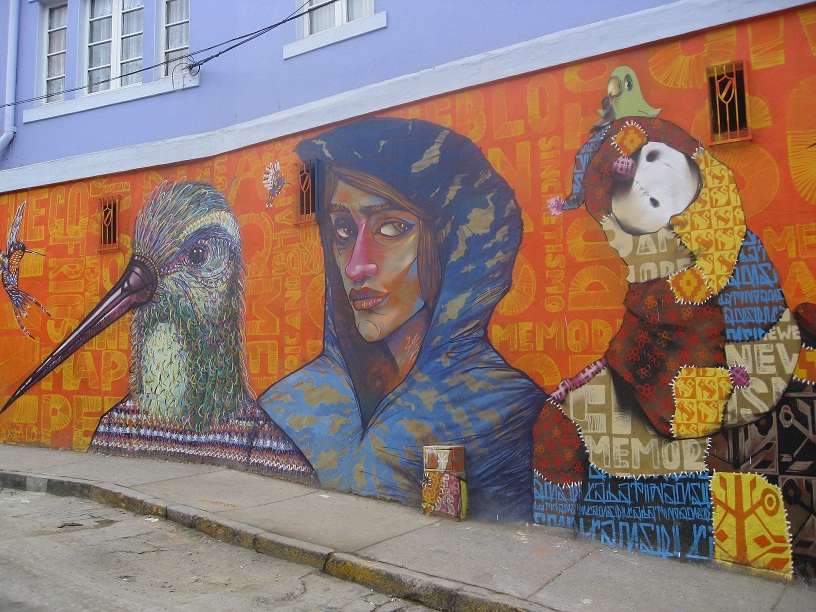
24 hours later, nary a Joshua Tree in sight and I’m in the country’s second city. Valparaiso is wonderful, managing simultaneously to be Chile’s capital of culture and menace. The city is a living, breathing art gallery - urban art gallery that is. There's clearly something in the water here as there's scarcely a wall unadorned with some type of graffiti. Then there are the hundreds of multi-coloured houses, piled high as far as the eye can see like some poorly assembled Lego set. They’re built on hills in a seemingly haphazard fashion, piled atop one another high into the hills which pour down into the Pacific. It isn’t a pretty city but it has character in spades. On arrival, the lady at the hostal seems to spend as much time telling me where not to go at night than she does telling me where to go during the day. The graffiti, though, takes the breath away - it’s everywhere and it’s impeccable. Banksy could well be mayor here.
Santiago is a mere two hours away and on the day I’m due to go there I have to wade my way through protesting students, riot police and not a little tear gas. The students are up in arms in Chile because the high cost of university education renders it impossible for many of them to pursue further education. They’ve been on strike for the past 2 months but the government stubbornly refuses to buckle. The protest I witnessed was utterly peaceful, wonderfully well organised yet still ended with police intervention. Democracies eh?
Santiago lacks the rough edges of Valparaiso, or so it seems in the three days I spend there, but it’s the most European city I’ve seen to date in South America. Bolivian cities are too poor to be European, San Pedro is too shit to be European, Valparaiso is too cool to be European, so it’s left to Santiago and it does it effortlessly well. Typing this now, I’m trying to think of an angle to take on Santiago, or to recount something interesting or unusual that happened there, but my mind’s a blank. It’s just another city; a big, elegant and ultra-modern city for sure, but not one that will live long in the memory.
One thing that should be noted about Chile, however, is the impenetrability of the language they speak. Yes, it’s Spanish, but in name only. It’s slurred, incoherent and completely ignores the pronunciation of certain letters, rendering it impossible to understand even the most basic responses. It’s frustrating, sure, especially coming so soon after the Bolivian drawl which was slow enough to allow you to take out your dictionary mid-sentence to figure out what they were saying.

San Pedro De Atacama


Moving on from Salar De Uyuni you’re left with that feeling you have when your hand scrambles around the box of Quality Streets late on Christmas Day, hoping to pull out a purple one but knowing that you’re probably going to snare a Turkish delight instead. Which probably does San Pedro De Atacama no justice whatsoever, but it's probably not far from the truth. There’s trouble getting here in the first place as we’re informed that our original route across the border is closed due to heavy snowfall. Javier, without pissing and moaning in the slightest, takes it upon himself to drive us to the border further north at Avaroa, convenient for us but ensuring a full day’s driving for him in a circuitous route back to Tupiza. Hugs and a heavy tip are exchanged as we wave goodbye at the Chilean border.
And the second we’re in Chile, everything’s different - impressive roads, not so impressive bus drivers, well-heeled folk strolling the streets with an insouciance absent in Bolivia and extortionate prices. Jesus wept. In short, take any item you’d find in Bolivia and in order to figure out the equivalent Chilean price, simply multiply it by four. Or five. Initially it’s impossible to get used to. After a month of eating copious amounts of food for absolutely nothing, it’s looking like the next three weeks will work in reverse. And the early signs are that it doesn’t look as if chicken is the staple food of the nation either which is nice, if you’re a vegetarian and you've just come from a month in Bolivia. Or a chicken of course.
The town of San Pedro De Atacama is built within an oasis - we’re up close and personal with the Atacama in these parts and the town was established by cattle herders driving their herds across the Andes. If they were to know what it would become they probably wouldn’t have been arsed. Though its setting is flawless - all volcanic lunar landscapes and snow-capped volcanoes - San Pedro itself is an IKEAn flat-pack town that’s been hastily assembled to cater to the hordes of tourists there to gorge themselves on the surreal and psychedelic landscape. On arrival by twilight, it seems as if the place is populated solely by the type of people who I imagine would attend the Burning Man festival, and who tuck the kids into bed before wandering off into the desert to drop some LSD and gaze at the skies. It’s a retirement home for dropouts from the Jim Rose circus. Yes, I’m a professional cynic but my heart is in it.
The purpose of San Pedro today, ironically, is to help people spend as little time there as possible which suits me fine. There are hiking trails aplenty nearby but if you wish to climb some of the 6,000m plus volcanoes in the vicinity you’ll have to join a group of about 25, be dropped off just below the summit, scale the 500m or so to the surface, have a quick lunch with your new friends and come back down again. Jesus, I hated San Pedro. I did spend one fantastic day though at the neighbouring lunar wonderland of Valle De La Luna. If apes bearing weapons, speaking English and sporting Star Trek like uniforms were to descend from the heights, I wouldn’t be slightly surprised - this is classic Planet of the Apes territory. I rent a bike for the day and cycle deep into the heart of it all. The furthest point from the entrance to the park is some 12km in at a rock formation called ‘Las Tres Marias’ and it’s there that my tyre decides to explode spectacularly. In short, this leaves me fucked and facing an 12km hike just to get to the entrance and a further 5km hike to San Pedro. But I’m not really expecting to have to walk all the way there - there’ll surely be several offers of lifts from friendly Chileanos seeing a guy down on his luck. With each passing car - and there were many - my faith in Chilean generosity fades. I meet the buses ferrying the tourist hordes eager to see the sun set in the park and I eat their dust as they ferry them back to San Pedro once more, leaving me and my bike limping home back into San Pedro long after darkness. It’s time to move south.

Wednesday, June 29, 2011

The Salar De Uyuni


In a country blessed with an abundance of natural beauty, Bolivia’s southwest walks away with the plaudits for the most beautiful region in the country. The Salar De Uyuni which is the stellar attraction here is found in Bolivia's Altiplano region, a high plateau formed by uplift of the Andes mountains. (Thanks Wikipedia.) This entire region looks like a landscape that‘s been photoshopped in advance before you've taken your camera out of your pocket. Photographs can only diminish its beauty. It’s a wishlist of nature’s most stunning natural occurrences; volcanoes both active and dormant, impossible rock formations, spurting geysers, snow-capped peaks, multi-coloured lakes dotted with shocking pink flamingos, traditional Aymara rituals and celebrations, the glorious Salar De Uyuni, a cemetery for trains and overly excited camera toting Germans determined to get the best shot at your expense. Phew.
Getting there is easy but choosing the right company to do the trip with is the tricky part. There's little to choose between the tour companies with regard to price but it’s the service factor where your choice can leave you either helpless and shivering beside a rusted 4WD some 4,000m up or being driven around in comfort in a heated jeep by a driver/guide who knows where to lose the crowds. In the end I go with Tupiza Tours and on the morning of Day 1, our group (there’s a maximum of 5 per group) meet with Javier, our driver, and Celia, our chef and pile into the 4WD which will get us through the rugged landscape over the coming days. I’ve opted for 4 days and 3 nights, at the end of which I’ll be transferred to San Pedro De Atacama in Chile.
Day 1 is easily the least compelling of our 4 days and yet still offers up some incredible views as we make our way slowly, climbing all the way to the city of Uyuni. We pass by the scene of Butch Cassidy and the Sundance Kid’s last hold-up and soon after, they met their maker in a neighbouring village. As the light drains from the day we make our last stop at Uyuni’s train cemetery, an oddly beautiful place where decades old steam engines lie to rust out their last days. We spend the night in a nowhere village, a tantalising 5km from the Salar.
Day 2 begins before sunrise and Javier drives us onto the Salar just in time for sunrise. As we make our way in the darkness we can already see the blinding whiteness of the Salar outside. At 10,500 sq km in area, finding a spot to ourselves is easy. Once the sun rises, the magnitude of the place becomes apparent but nothing prepares you for just how beautiful it is. Two colours dominate - the blinding white of the Salar with its hexagonal shaped salt crystal formations stretching as far as the eye can see where it meets the softer blue of the sky. Javier, it turns out, is not only our driver but also specialises in capturing those cheesy tourist photo moments on the Salar. His props include a toothbrush, cracked egg shells and us. Our two friends from Hong Kong willingly accede to each and every one of Javier’s photo requests.
I’m pretty certain that the Salar De Uyuni is the most beautiful place I’ve ever visited. Right in the heart of it there’s the Isla Del Pescado, home to gigantic cactii, incredible views of the Salar but otherwise uninhabited. In the early morning light the place is awash with epic vistas in all directions. Our luck’s in too as on the day we arrive on the day that the Aymara people are on the island’s highest point celebrating their New Year. As we make our way to the peak there’s a group of about 60 gathered together, two llamas lying to the side their throats cut offered up as a sacrifice. There’s no tiring of the views of the Salar even after 5 or 6 hours driving and stopping, emptying out of the jeep to take the same photos over and over again. Everything after this is bound to be an anti-climax.
Except it isn’t. Day 3 brings us higher, above the 4,000m mark to a region where still active volcanoes smoke and where the lava from previous eruptions has hardened into comically shaped rock formations. None moreso than the Arbole De Piedra - a tree shaped rock seen above - which is just one of several remnants of past volcanic eruptions combined with the effects of the elements this high up. From there we drive across the treeless landscape making our way to the Laguna Colorado but not before our first encounter with some of the region’s flamingos on one of the many other lagunas which litter the place. On arrival there’s a flock of about 15 but by the time we leave there are maybe 50 or more, tantalisingly out of reach for a decent photo on a shit camera.
Our last stop of the day is also the most breathtaking - the Laguna Colorado. It isn’t the size which beggars belief but the colour - huge bright red patches caused by the sun’s reflection on the algae which infest the place. It too is peppered with flamingos, the whole place a photographer’s wet dream. Normally picking the 5 photos Google allow me to use above each post is pretty straightforward but for this one I could have included 50. I think I took almost 200 photos on Day 2 and am finding it impossible to reduce that number. Not sure anything can top these 3 days for natural beauty.

Friday, June 24, 2011

Getting high in Potosí


And so my travels have come to something of a sprint finish. With notions of dipping my toe into the waters of Chile, Peru and Ecuador before I depart for home, travelling has begun in earnest once more and having spent two days exploring Sucre, Potosí is next on the list. It’s a remarkable city in that it’s found at a lung-bursting 4,070m above sea level, quite a jump from Sucre’s more bearable 2,700m. From now on in Bolivia it’s all going to be about getting high. Potosí is probably most famous for its co-operative mine in which miners work in Victorian-era conditions; its gnarly ladders, unventilated shafts and wildly fluctuating temperatures adding up to a miserable existence to the hundreds who try to make a living there. There’s a tour to the mines which is aggressively sold but which I steer clear of mostly to avoid coming across as a day-tripping western coming to mix it amongst the filthy masses struggling daily to make a living in life-threatening conditions. The fact that I’m claustrophobic and afraid of the dark has absolutely nothing to do with. Whatsoever.
Besides, there’s much to see and do in and around Potosí. The city itself is as undersold as the miners’ tour is oversold. In common with Sucre it has an old world charm, a beautiful, if gaudy, central plaza and some of Bolivia’s finest budget accommodation in refurbished colonial-era houses. There’s also some wonderful trekking in the vicinity so I trek up to the Lagunas de Kari Kari, in themselves unspectacular, but set amongst the rolling hills above the city and offering perfect views of the urban sprawl below. The trek also gives me my first close encounter with llamas. Dublin zoo probably has some llamas but in common with most of the animals there, they were probably ‘asleep’ on the day I visited as a youngster. Llamas are weird, having all the characteristics necessary to be a sheep but it’s that downright weird fucking neck which makes them stand out. I take some photos, self-consciously peering over my shoulder as I do for fear that some locals will laugh at me for taking snaps of what are, after all, the South American equivalent of sheep.
During my time in Potosí I was also encouraged by none other than Hugo, my Spanish teacher, to visit the city’s National Mint museum which was reason enough to give it a miss but I decided to check it out regardless. There’s a tour in English which is ideal because unless our guide wants to repeat instructions about how to order a hotel room or how to buy a kilo of oranges in Spanish during the course of the hour the tour lasts then I’d be completely lost. She turns out to be Bolivia’s most cantankerous woman. Having shown us a display featuring some of Bolivia’s coins from the past and having encouraged us to ask questions if we had any, I meekly enquire as to why - as she previously had alluded to - Bolivia doesn’t mint its own coins any more, she curtly responds “Because it’s cheaper in Chile.” Right. Thanks for that.

To Sucre


There’s official time and there’s Bolivian time. If, for example, you’re told that a bus journey will take 14 hours, you can safely assume that this means 18. Leaving Santa Cruz behind to move to Sucre, I’m informed that the overnight bus will be in Sucre (still the constitutional capital of Bolivia) by 7am so I anticipate a noon arrival. It’s a 17 hour journey and within an hour of being on the bus I’m being squeezed from the front and behind for good measure - the prick sitting in front of me has already reclined his seat fully and there’s a kid sitting on his Dad’s lap behind me and is kicking my seat with monotonous regularity. There’s not much that you can do on a 17 hour bus journey but grin and bear it. There are roughly three stages to a bus journey like this;
1. Stage I - The ‘Wow, it feels wonderful to be on the road again, getting the chance to see the countryside pass me by and seeing the locals go about their business on the charming villages which litter the route’ stage.
2. Stage II - The ‘Christ, I’ve only been on the bus for 7 hours, I can’t sleep even though everybody on the bus seems to be in a deep slumber except for the child behind me who is still kicking the back of my seat with the aforementioned monotonous regularity and when do we get to stop to take a piss?’ stage.
3. Stage III - The ‘Only 5am in the fucking morning - wasn’t it 4.30am three hours ago - driving through yet another tedious fucking village, 7 hours from our destination, neck and back no longer on speaking terms, unsure of whether I’d rather eat or vomit’ stage.
All of this and a road surface which must surely have been used for quality control testing of landmines mean that by the time I get to Sucre (not long before noon strangely enough), all I want to do is leave again. But Sucre is wonderful, a beautiful old city with magnificent colonial buildings, dazzling whitewashed facades and a little bit of history around every corner. In common with most Bolivian cities it also has a wonderful central plaza where the young and the beautiful sit around (and me too) eating ice-cream and sipping on freshly squeezed orange juice. There’s a fantastic market where you can sit and drink freshly squeezed juices for the day if you so wish.
Now that I’ve left the security of Santa Cruz, it’s sink or swim time with my Spanish. On arrival in Sucre, tired and grumpy I make my way to the hotel and will have to utter my first official words in Spanish without having someone there behind me to clarify that what I’ve just said was indeed Spanish. I’ve even visualised the scene a few times, strolling into the foyer, casually enquiring; “Tienen habitaciones libres para dos noches?” However, by the time I get there not even I understand what comes out of my mouth, yet somehow I’m understood and I leave the reception, key in hand feeling like the road to fluency will be a short one. I almost feel like going back to reception and engaging the receptionist in a breezy conversation but, hey, Rome wasn’t built in a day. Mañana, quizá mañana.

Wednesday, June 15, 2011

Lo Siento Pero No Hablo Espanol

I have two and a half months of travelling left and all of that time will be spent in South America and at this stage I’m sick of surviving on a few words here and there in the local language. The aim is to develop my non-existent Spanish skills to a level beyond the usual ability to ask for a room or order some food. Of course I don’t expect to be able to discuss Aristotelian philosophy once August rolls around but to have developed some functional conversation skills should be achievable. So it was that decided to spend two weeks in Santa Cruz attending a language school where I would attend lessons for 4 hours a day, 5 days a week. My teacher was Hugo whose motto, which he endlessly and irritatingly repeated, was “To love all and to serve all.” As part of this immersion in all things Spanish I spent two weeks living with a Spanish family, sharing meals with them and watching an unending stream of Mexican telenovellas.
Things started pretty encouragingly when Hugo had written the aims and objectives of the two week course on the board as I arrived on Day 1. Initially my enthusiasm was boundless and the first couple of days began with an introduction to the verbs in all their various forms. By Day 3 though it started to becomes clear that the aims and objectives of Day 1 were quickly forgotten and instead we’d spent relentlessly tedious hours reading over verbs and random articles in magazines that I couldn’t understand. I was at the Sesame Street stage of Spanish and Hugo was half expecting me to translate Ulysses. I can barely read the fucking thing in English. So it continued for the rest of the week. I’d explain my very basic language needs, Hugo would acknowledge them and then completely ignore them. His motto was rapidly becoming “To love all and to teach fuck all.”
Meanwhile over with the family, things were progressing pretty smoothly. I had my own room and three meals a day which offered the best chance of interaction with the family. Truth is that I couldn’t understand a word of what the mother or father were saying but fortunately their daughter understood that I was patently hopeless when it came to Spanish and spoke to me like I was Forrest Gump. This left things awkward at mealtimes as the family spoke less because there was a stranger in their midst and I spoke little because I didn’t know how to. Many times I’d begin a sentence only to be half way through and realise that I didn’t have the words to finish it. Everyone would stare, waiting to hear what I had to say but I’d give up and reach for the spoon and shovel some soup into my mouth. As the two weeks passed though I did develop the ability to sprinkle some banal sentences throughout mealtimes which made it seem like I was making an effort. In typical Irish fashion though, many of these were about the weather.
Back in the classroom with Hugo things didn’t improve. Hugo is from the school of teachers who believe that once something unknown is written down it automatically becomes known. The few things I felt that I had understood previously - use of direct and indirect objects for one - Hugo managed to unravel completely. We’d spend an hour each day watching a film in Spanish which would have been fine if there were some activities based on the film but no. So it was that I had to sit through ‘Love In The Time Of Cholera’ with Spanish subtitles. If you’ve seen the film you’ll feel my pain. Ironically enough, Spanish seems to be a relatively straightforward language to learn. Here’s a pretty good example of what I mean. Opening the English-Spanish dictionary under S, here’s five consecutive words and their Spanish translation;
soccer - futbol
sociable - sociable
social - social
socialism - socialismo
society - sociedad
At one stage I even looked up the translation of ‘bestseller’ to find the word ‘bestseller’. Magic. Who could not love a language like this? Who could not teach a language like this? Well, Hugo for one. By the end of the course, by accident or design I’ve managed to develop the ability to converse at a very basic level and have two more months left to work on that. I just hope Bolivians like to talk about the weather.

Tuesday, June 14, 2011

To South America

Vegetarians, be afraid. Be very afraid. Welcome to Santa Cruz, Bolivia, the most carnivorous of all the cities I’ve visited to date on this trip. To be honest, I wasn’t aware of Santa Cruz’s existence until I found a cheap flight here from Frankfurt. It’s rarely mentioned in the same breath as Bolivia’s other urban heavy hitters such as La Paz, Sucre and Cochabamba and it‘s easy to see why. It’s quite the underwhelming place and under normal circumstances it would serve as an urban doormat, welcoming me to the country before I made my way to Bolivia‘s other urban jewels. I’m here for two weeks though and for one reason only - to learn Spanish. Having travelled through West Africa for 2 months and having added approximately 5 words of French to my vocabulary, I’ve decided that I’m sick of struggling with the local language and so I’m going back to school.
I find it impossible to write about my initial experience here in Bolivia without making reference to food. The streets of Santa Cruz are lined with street vendors. You can eat anything you want here, as long as it contains chicken in one of its multitudinous forms, and chips. Santa Cruz is the embodiment of the fat guy who says “I don’t have a problem with my weight. I eat, I get fatter. No problem.” The only living thing more worried than a vegetarian here in Santa Cruz is a chicken. If I was playing a word association game and the words Santa Cruz were uttered, my immediate response would be ‘CHICKEN’. Roasted. Broasted. Fried. Smoked. Grilled. Baked. Barbequed. Shit, if you wanted your chicken dressed in a tutu and smoking jacket, I‘m sure that even that wouldn‘t be a problem. As long as you ordered it with fries of course. I don’t know what the statistics are with regard to coronary disease in Bolivia but if Santa Cruz is anything to go by then I’m pretty certain that it’s one area in which Bolivia is a world leader.
I spend two weeks in one of Santa Cruz’s outlying neighbourhoods and it gives me a good chance to see life here up close. On my first day in the neighbourhood, wandering in search of a bottle of mineral water, I pass by shop after shop with metal bars across the entrances and so I walk on assuming they’re closed. It turns out that they’re not - the bars are in place as a type of security blanket for the shopkeepers, fearful of armed robbery. It takes some getting used to though, shouting your order in through the bars and waiting for it to be passed through the little hatch. It all leaves me feeling like saying “A Mars, a bottle of Coke and my conjugal rights please. Gracias.”
The bars are a symbol of the fear which is whipped up and served thick (with chicken and fries probably) on a daily basis by the endless number of lowest common denominator tabloid news programmes which are only outnumbered by the deluge of telenovelas from Mexico (and you thought The Young And The Restless was overcooked). It’s a wonder some folk leave their homes at all given what they witness on the likes of Uno, to name but one station. Genocide, pestilence, sexual assault, global warming, rioting - and all of this happening in the local supermarket - all form part of a daily dose of an around the clock onslaught of intimidation and fear. It’s like Eastenders, only real. Uno seems to have a team of reporters whose job it is not to seek out stories in the various neighbourhoods of Santa Cruz but to whip the locals into a frenzy which would explain how they never fail to be there on time to see a local gangster have his face rearranged by a kicking and spitting army of seething mujeres.

Tuesday, May 24, 2011

The Facts and Figures of West Africa

Number of countries visited: 6
Number of countries visited for under 24 hours but which have still been included in the above: 1
Number of meals eaten without looking at the food and swallowed without chewing: 240
Number of times “Only fucking rice again” muttered at meal times: 317
Number of snakes seen: 0
Number of hippos seen: 0
Number of any type of wildlife seen that might set the pulse racing: 0
Number of goats seen: 345,789,897,009,456,907,345
Irritating Rastas fended off: 29
Irritating Rastas fended off without recourse to ‘Would you just fuck off?’: 0
Official ticking offs from authorities: 2
Number of bribes asked for by border officials: 0
Number of mangoes eaten: Refer to ‘number of goats seen’
Words added to personal French vocabulary: 0
Most people squeezed into a sept-place: 14
Hours waited for a supposed trip on the Niger: 8
Number of trips taken on the Niger: 0
Number of saints in Timbuktu: 333
Number of meals eaten in Timbuktu that didn’t contain sand: 0
Reasons for a return visit to Timbuktu: 0
Number of guides encountered who wanted me to teach them gangster lingo: 1
And the ‘Our Father‘: 1
Oh, and ‘Hey Jude’ too: 1
Number of times hearing the ‘Our Father’ thereafter: 105
Number of farmyard animals that shat on me on public transport: 1
For everything else there’s Mastercard. Except there’s not, because Mastercard is fucking useless in West Africa.

The Language Barrier


I’m in Gaoua now, right in the heart of Lobi country and within spitting distance of the borders of both Cote D’Ivoire and Ghana. It’s essential here to secure the services of a guide to explain the esoteric customs and traditions of the Lobi people in the surrounding villages. Trouble is that there are no English speaking guides here and so I‘m compelled to go with a French speaking guide and hope that I can make some sense of what I‘m being told. Oral communication, when you think about it, is as much about interpreting signs and understanding gestures as it is the physical act of talking and listening. Imagine for a moment that you’re speaking to a person from a different country and they’re using a language you don’t understand. Well, what you do understand is that language is about taking turns, giving and taking and, ultimately, understanding. So if you listen to someone from another country speak and they stop speaking then you’ll know it’s likely that either;
(a) they’ve just told you something and, probably,
(b) they’re waiting for you to respond in some way.
But today as my guide spoke I realised how, even with the most embarrassingly poor French vocabulary after two months spent in French speaking countries, most words that we use are window dressing i.e. I could understand almost completely what he was saying by throwing a mental lasso around the few words I did understand and use some common sense to figure out from his gestures and intonation what it was he was speaking about. It was an experience akin to watching a Latin American soap opera. Or Fair City. You don’t understand the language but you can figure things out pretty well.
Now when it comes to speaking the language, that’s an entirely different matter. No doubt my comprehension of the language has improved in the past two months but I’m still stuck in first gear when it comes to developing a conversation and it’s frustrating for all parties. I’ve generally avoided conversations with the natives because once my limited reserves of pidgin French have been used, I’m marooned. To compensate for my vocabulary deficit I’ve discovered a new technique which is completely useless but helps me feel a little more eloquent. When I don’t know the French for a word I simply use the English word, dress it up in a haughty French accent and continue unperturbed as if nothing unusual has happened. I’ll even attach an ‘un’ or ‘une’ to each word I’ve made up just to make it seem more authentic to me and make it sound even more casual. Perfect and it‘ll work well in South America too, simply by replacing ‘le‘ with ‘el‘. Useless for comprehension of course but it gives me the impression that I’m conversing like a native speaker. In turn it gives the native speaker the impression that they’re conversing with the village idiot. Take these two sentences by way of example;
“Pardon, il-y-a un stat-eee-on de petreule ici?”
“Merci beaucuop pour votre hos-pee-tal-ee-tay.”
I know it's stupid, the person who hears it definitely knows it's stupid but everyone's too polite to say that they've noticed anything.
When I’m listening to someone speak, rather than give the impression that I don’t understand them, I’ve learned how to buy time in any conversation. I've decided that I'm better off lying than stopping a conversation every two minutes saying that I don't understand. Whoever said that honesty is the best policy spoke French fluently. It might be a small word but ‘oui’ has become my best friend, the glue that holds my conversations together. There are many different ways of using ‘oui’ to prolong a conversation. To begin with you need to put several ‘ouis’ together - ’Ah, oui, oui, oui, oui, oui’ usually works well - and from there it all depends on your tone of voice. There are the profound ‘ouis’ uttered with a straight face and a nodding head when you think you’ve been told something of great historical relevance or of philosophical importance, the knowing ‘ouis’ said almost in a giggle when the speaker ends his sentence with a smile or the quick fire ‘ouis’ scattered throughout somebody’s sentence which, though you’re completely lost, the aim is that if you say ‘oui’ often enough, it might not be completely obvious to them and reduce the chances of you needing to respond when they‘ve finished speaking. There are questioning ‘ouis’, uttered with a tilt of the head and a furrowed brow, long winded ‘ouuuiiiiis’ which signify agreement and are accompanied by a knowing smile. By now, you get the point.
Finally, like the Guy Pearce character from Memento, I live exclusively in the present tense when I’m speaking French. I’ve long since forgotten the construction of the past and future tenses, which are pretty important in any language, but I camp myself stubbornly in the present tense, as if what I’ve already done is irrelevant and as if I couldn’t care less what I’m going to do, so why bother discussing it.

Chickenshit

There are many things which can go awry when using local transport to get from place to place in West Africa. Ultimately, though, it’s the only way to go because of the fact that you’re mixing with the locals and it’s the best way to view West Africa at ground level. Christ, imagine driving from Mopti to Timbuktu without disembarking covered in red dust from head to toe. Well, that would mean that you were just there to visit Timbuktu and that would be stupid, wouldn’t it? Anyway, I digress. If it’s comfort, air-con, breathing space, odourless bodies and animal free environments that you’re after then local transport is not for you. And yet some of my best memories come from literally painful drives I took, for example, to the eastern Senegalese town of Tambacounda or the aforementioned endurance test to Timbuktu and back.
I actually thought that I’d finished with local transport when I arrived in Burkina as it’s top heavy with decent coaches to bring you to all parts of the countryside, but not so. The trip from Banfora to Gaoua takes some five to six hours along the reddest and dustiest track in all of Burkina. As ever on these trips as soon as someone is dropped off and you have momentary breathing space, there‘s another quickly along to fill the space vacated. A breathless woman arrived clutching a hen tied by its claws underneath her arm - this is the norm in these parts and many buses usually travel with at least a dozen tethered goats on the roof - in one swift moment she clambered on to the seat beside me, I happened to glance down at my shorts and notice a few dark brown splatters on my right leg, but before I could investigate any further she’d squeezed right in beside me.
‘The chicken's shat on me,’ I think to myself, quick on the uptake as ever, but as yet I’m unaware of just how much shit it is. As we’re driving along and before I’ve had a chance to investigate the damage further I’m wondering if it’s the Coke bottle effect - did she drop the fucking chicken as she ran to catch the bus and then, as she entered, it was all too much for the chicken who vigorously emptied her bowels having been shaken a little too much along the way. Before long the stench starts to spread throughout the bus but of course no-one has any idea where it’s coming from.
It’s only when I get out later to stretch my legs that I realise how bad it is - Jesus, what did that fucking chicken eat? If you took a cow turd, put it in a blender and squirted that on my leg then that would roughly correspond with what came out of the chicken‘s arse and landed on my thigh. Every time I got off the bus thereafter I self-consciously turned my body away from the bus hoping that no-one would notice. But there’s always at least one smart arse on every bus with eyes in the back of his head - this one unfortunately had the biggest mouth too. He sees the shit, points it out to me with a big stupid smile on his face - like, I hadn’t noticed it - and then the prick points it out to everyone else on the bus (I‘d have done the very same). Instant mirth ensues with everyone wondering if le blanc has shit himself. Is this what westerners do on long bus rides? I shrug my shoulders, pretending that I really couldn’t care less but the shit slowly oozing down my leg and my reddening features suggest otherwise - a clear case of protesting too much. The woman who owns the hen realises what’s happened, springs from the bus and spends five minutes wiping my shorts, me standing trying to look nonchalant with the eyes of the bus on us, the vehicle practically shaking with laughter by now.
A few stops later I get moved to the front of the bus - out of sympathy or due to complaints from the back it isn’t clear - beside the driver, and the guy who sits in next to me immediately produces a bottle of aftershave, sprays my shorts, sprays himself, the front of the bus and aims a few squirts into the back of the bus from where me and my shit sodden shorts have just emerged. Great, thanks. Happily, by the time we arrive in Gaoua there’s that much red dust on me and everyone else that the shit has become obscured. I’ll miss all of this of course.

Banfora and south west Burkina


So then, just two weeks remaining in West Africa and there’s little point in racing around for one week in Burkina and the same for another week in Togo or Benin (tempting as it is) which would leave me understanding little of either. If you drew a diagonal line across Burkina from Gorom Gorom in the north east you’d cross Banfora in the very south west of the country. It’s a quiet place in the heart of some lush countryside and perfect to spend some days unwinding as there are three or four sights within easy reach. There’s also a hotel there with a dorm which, due to the fact that it’s low season, is ostensibly a single room with a different bed for me to sleep in each night that I stay there should I wish to do so. To explore the surrounding area I get myself on a scooter which is initially nerve-wracking as I haven’t sat on one since Vietnam. It isn’t difficult finding wheels especially when the guy who rents them follows me every millimetre of the 1.5km from the bus station to the hotel. Surprisingly I still haven’t worked out the French for ‘Fuck off’ but in this case I don’t think that it would have worked anyway.
Two of Banfora’s biggest attractions are the Karfiguéla waterfalls and the Domes de Fabedougou which sit conveniently side by side. There’s nothing convenient about getting to them though especially when the Lonely Planet directions there send you in completely the wrong direction leaving me to ask 20 people for directions - it was at least 20 - until I find what I’m looking for. The waterfalls are unspectacular as it’s the height of the dry season though you can easily see how stunning they might appear during the wet season. The beauty of the Domes however leave nothing to the imagination. The necessary geological terms elude me to describe them accurately so in layman‘s terms if you can imagine gigantic cow turds made of limestone scattered for miles around then you‘re almost there. Beautiful place.
Sindou Peaks however is where all the action is. On the day I visit I’ve got the place all to myself and I feel like a child who’s been left behind because they got the head count wrong at a play centre. Though the approach to the peaks is impressive it’s only once you clamber into the heart of the area that you appreciate how incredible the landscape is. There are peaks everywhere you look, many of them offering themselves up as challenging but achievable climbs and I spend three to four hours there walking around, giddily looking for the next scramble. I climb to one of the highest peaks around, enjoy a little picnic and ring my niece who’s worried she won’t get out on to the bouncy castle for her Communion day. You can walk for hours here deeper and deeper into the park area and climb for as long and as high as you wish. It’s a remarkable place. It is a 100km round trip there on the scooter - I’m standing as I type this - but Sindou, for me, is the jewel in Burkina’s crown.

Wednesday, May 11, 2011

Gorom Gorom


One of the more remote outposts in a country filled with remote outposts is to the north east of Ouagadougou, to the town of Gorom Gorom deep in the heart of the Sahel. It’s a 6 hour bus ride to the town of Dori from Ouaga along a surprisingly good road and then a two hour wait for a minibus to fill to bring me further along a dirt road to Gorom Gorom. In spite of its abject poverty, Burkina has a phenomenal collection of bus companies to choose from - shit, one of them has air-con - all willing to bring you to the remotest parts of the country. In all of the countries that I’ve visited in West Africa to date, Burkina is by far the best served by public transport, not at all what I‘d expected. I am starting to miss the sept-place experience a little though.
The reason I’ve come this far is for Gorom Gorom’s famous Thursday market. These markets are an essential part of the lives of people in remote areas like this, offering them a chance to bring their produce from outlying villages and make enough money to buy whatever’s needed until the following week. It must be said though that what’s on sale is pretty disappointing - large amounts of plastic Chinese tat outnumber the traditional arts and crafts I’d hoped to see. The market though is a roll call for ethnic groups in this region, from the slightly sinister looking Tuareg males with their loose robes and prominent swords, to the Fulani herders with their conical hats to the Fulani women, famous for their beauty, bedecked in psychedelic dresses, their faces almost lost in the jewellery they wear. One of the best parts of the day is sitting and watching the traders arrive and depart from neighbouring villages on foot, moped, ass and cart and, for the Tuaregs, on camel back.
As with everywhere in Burkina Faso there are some pretty enduring images of poverty here. Eating becomes an almost uncomfortable experience as scores of ragged children lie in wait with their plastic buckets for anything you might leave for them when you’ve finished your meal. And there are children like this everywhere here, many of them AIDS orphans. Life expectancy in Burkina Faso is just over 51 and I’m tempted to believe that it’s below that here in the heart of The Sahel. There’s a running battle between the restaurant proprietors and the children, who stand wide-eyed and eager for an invitation to take what you don’t want to eat. I’ve never witnessed poverty on such a scale and I haven’t managed to finish a meal here yet, knowing that there are scores of hungry eyes waiting and watching.
There’s the constant dilemma - in my head at least - of whether or not to be taking photos here, feeling as if I’m just being the typically ignorant tourist taking pictures for the holiday slideshow at home - “Look, a poor black person” - whilst stepping across the beggars in the street and hoping the kids with their plastic buckets don‘t ruin the shot. I do feel as if there is something almost indecent about taking pictures of people mired in misery as many of these market traders and villagers are. That’s probably overstating it somewhat but, regardless, most of my images here are mental ones. There’s also the fact that the Fulani women in particular are fiercely reluctant to have their photo taken as a fellow Swiss-German traveller discovered much to her disappointment. I’ve long since stopped asking people if I can take their photo as I realise most of them are unwilling and those who oblige want payment.

Ouagadougou


Ouagadougou. Wagga-doo-goo. Or quite simply ‘Ouaga’ as it’s commonly known. It sounds like what you'd end up with if you joined the name of a northern Queensland town to that of a Welsh village. Or a Cocteau Twins' B-side. Just brilliant. Anway, I’ve been here a week already and there are many things which separate Burkina from its West African counterparts. First off there’s the appalling poverty which is far more pronounced here than it had been in any of the other countries I’d visited. In spite of this, without any hesitation I’d say that the Burkinabé are the friendliest and most welcoming people of any country I've visited in West Africa. It’s overwhelming and humbling in equal measure. Remember that this is one the poorest nations in the world and yet I have been the recipient of countless offers of spontaneous generosity in my short time here. Most of these people earn less than $1 a day but they‘ll think nothing of buying you a sachet of water when you‘re sitting on the bus beside them. To put it into context, that’s about one eighteenth of the average daily wage here.
Because of the poverty, families tend to be of old Irish Catholic dimensions - the more children there are, the more workers there will be to provide for the family is the logic. Infant mortality rates are high though and under 25% of the population are literate. The children the many many children here are fascinated by the presence of a ‘blanc’ and are fearless in approaching me. Several times I have been walking down a back street, to hear children begin a chorus of ‘Tu vas ou?’, quickly followed by a child -usually the eldest, around 3 years old - rushing out to grab on to my finger as I walk past. This then sets in motion a blur of kids, each rushing out and all of them grabbing on to the 9 remaining fingers until their mother barks at them to stop hassling the foreigner. Either that or she’s told them not to bother, that he’s clearly a tightarse.
There’s also the honesty of the people. Very often in West Africa - Mali in particular - there’s an unofficial ’blanc’ tax which adds 10 or 20% to the price of your taxi, dinner or even a mango. Not so in Burkina Faso. Everything I buy is for the same price as the locals. In Mali, whenever I bought something and asked ’C’est combien?’, there was a discernible pause when you could see the person think ’How much can I add on and get away with here?’ Mali needs to get its shit together in terms of holding on to the few tourists it’s getting these days - Sarkozy, the pint sized fuckwit, certainly hasn’t helped things - and not milking them for everything they can, a bit like Ireland with the Americans, only the Americans have stopped coming in their droves now. Burkina is a much poorer country than Mali and the people are happy that you’re here so the emphasis is on welcoming you rather than ripping you off. Very refreshing and a credit to the Burkinabé.
Ouagadougou, in spite of its amusing name is, much like any other West African capital city, largely charmless. There’s little to see but it’s a hell of a lot more inviting than, say, Bamako or Dakar and certainly has a warmer atmosphere but, again, that‘s down to the people. It does have a strong tradition of sculpting and, surprisingly, film-making and it hosts one of Africa’s biggest film festivals - FESPACO - each year. A walk around Ouaga’s streets will involve several invitations to see an artist’s studio or workshop but there’s none of the hard sell encountered elsewhere. In many ways Burkina seems unique in West African terms and just one week in it’s rapidly becoming my favourite country in this part of the world.
Apparently there’s a curfew in operation in Ouaga at the moment from midnight to 6am, though not that you’d notice. Apparently there’s quite a bit of unrest here with the army and the police force both protesting because of their poor rates of pay. I spoke to a fellow traveller who on her first 3 days in the country wasn’t allowed out of her hotel once because the army had taken to the streets as a show of force and to demand higher pay. She described hearing explosions, breaking glass and sporadic gunfire - I have no idea who they might be shooting at - though I’ve witnessed none of this in my two separate visits here. The unrest here is nothing like what’s happening in Libya or Syria though, it’s more a case of chest thumping by the armed forces to better their collective lot.

Sunday, May 8, 2011

Pays Dogon


My last Malian port of call is to Pays Dogon, near to the border with Burkina Faso. Pays Dogon is home to the Dogon people, and it’s their strong tradition of animism and Pays Dogon’s spectacular setting which draws the crowds here, but this is April and only a fool would want to trek here at this time of year so this fool has most of Pays Dogon to himself. A guide here is essential, more for the avoidance of cultural faux pas and for ensuring a warm welcome, than as a navigator. Pays Dogon stretches some 150km along an escarpment known as the Falaise De Bandiagara (over 500m high in places) and along this stretch are the Dogon villages, many of which were built at the very base of the escarpment, though in recent years this tradition has died out. It’s immaculate trekking country as long as you choose your route carefully, preferably one which involves ascents and descents of the escarpment. As you trek north, to your left is the escarpment and to your right, the vast open Sahelian wilderness, dotted with hardy trees, which stretches all the way to Burkina Faso.
My guide for my 3 days here is Seck Dolo - I don’t think that I learned all that much from his insights into Dogon culture but he made for an entertaining sidekick. A daily highlight for me whilst I’m here is witnessing the greetings exchanged between people. A curt ‘ca va?’ will not suffice here, instead meeting someone on the trail means spending almost a minute enquiring as to the health and welfare of the other person’s family and extended family and then their extended family. Translated, it goes something like this;
‘Seck, how are you?’
‘Sewó’ (Great)
‘How’s the wife?’
‘Sewó’
‘And the children?’
‘Sewó’
‘The uncle with the bad back?’
‘Sewó’
‘And his wife with the funny walk?’
‘Sewó’
‘And their children?’
‘Sewó’
And on it goes until it’s the turn of the asked to enquire as to the health of the asker’s family. Walking with Seck over the course of the 3 days here I saw this ritual re-enacted again and again each day, and quite how no-one tires of it is beyond my comprehension.
As I’ve said, Seck is priceless company but he’s also pretty exhausting at times. Take for instance our first night in one of the villages, once the dinner plates have been cleared away, Seck declares his love of Christianity (he’s Muslim) and asks me if I know the words to the ‘Our Father’. Stupidly I say yes and so I’m supplied with a pen and paper and asked to write the words out and read them with Seck, as he wants to say it each night before he sleeps. Not only do I have to read them but explain them in great detail also. ’What is “Hallowed Be They Name?”’ etc. I feel like a benign latter-day Crusader seeking to reclaim some of the flock from the Islamic hordes but feel woefully underprepared for the barrage of questions he throws in my direction.
Not only is Seck interested in God but he also has a weakness for The Beatles. He hears ‘Hey Jude’ on my mp3 and he’s instantly smitten. Once again he insists on me writing out the lyrics - I tell him that he can write his own fucking na-na-na-na-na-nas though - and so the following day at the most random moments during our trek, the silence will be broken by a sudden enthusiastic burst of ‘Our Father, who art in heaven…’ or ‘Take a sad song and make it better’. Tiresome. He‘s determined to say all of the ‘Our Father’ too to prove to me what a good Christian he‘s going to be. I’m reminded about John Lennon’s quotes about The Beatles being bigger than Jesus. Well, in Pays Dogon he’ll have to settle for them being on a par with him.
Seck also wants to present himself in a more confident way. He tells me a story about a guy who’s been hassling his mother and he asks me to script some words to threaten the guy. He then begins suggesting scenarios, one of which is ‘Pretend that I’m a gangster’ and I have to put the words in his mouth once more. Again I do my best and so it is that night as I lie on the roof gazing at the stars, listening to the muted sounds of village life and drifting off to sleep, I hear the distant but threatening voice of my guide alone in the darkness at the dinner table repeating the words “I will hunt you down and I will fuck you up” in a range of different tones. Ah, desert life.
The further north you go, the more authentic it seems the villages are and so our first day is a pretty unremarkable trudge through the flat sandy trail walking through some pretty humdrum villages. Day 1 is remarkable only for my encounter with the village chief of Teli. Seck introduces me to a pretty unassuming guy who jumps to attention at the sight of a tourist. Clearly half-pissed on millet beer, he staggers off to throw on his hunting gear, fetch his rifle and within seconds he’s striking ‘hunting’ poses beside me - this is obviously a well worn routine. I have no choice in the matter. At one stage he hands me the rifle - I have no idea what I’m supposed to do with it - and starts striking pose after pose a la Austin Powers. In fact if I’d asked him to put on a Marilyn Monroe dress and sing ‘Happy Birthday Mister President’ for me then I’m sure he’d have done that too. Naturally this theatre isn’t free and I’m asked to hand over 1,000 CFA when he’s done. He quickly slips back out of his robes and is back on the lash again as if I’d never appeared.
Day 2 though sees us trek to the village of Yaba-Talu from where we climb the escarpment - stunning trekking through a narrow gorge - and trek across to the fairy-tale villages of Indelu and Begnemato. Both villages make the entire 3 day trek worthwhile due to their setting high atop the escarpment but also because of the sense of disconnection from everything around them. Mud brick houses with witch hat roofs abound as do little children pleading for a cadeau. Begnemato in particular has a sublime location, hidden high up amongst gigantic rock formations which take on a different hue as the sun sets. If one moment could encapsulate my entire time in West Africa to date it would be arriving here and seeing the village for the first time as the sun set and listening to the distant sound of village life. Absolute perfection. The following morning we take a ‘trolley’ i.e. an ox and cart back to our starting point and trek back to the village of Djiguibombo. I haven’t actually learned all that much about the Dogon people or their animistic beliefs but for Day 2 alone and our trek up the escarpment, it’s been a worthwhile experience. I part company with Seck after he drops me back at Bandiagara - me to make my way to Burkina Faso, and him to hunt someone down and fuck them up.

Saturday, May 7, 2011

Timbuktu


A word of warning in advance - if you’d like to retain that intangible sense of romance and mystery which has been attached, for whatever reason, to the name ‘Timbuktu’, STOP READING NOW. If you don’t give a shit, let’s get down to the business of myth busting. I’d started to doubt its very existence myself due to various difficulties getting here, but finally, after 48 hours of strife and a lifetime’s supply of dust for my lungs I made it. Timbuktu as a name is certainly one of the more romantically evocative - suggesting an historic, far-flung, remote Saharan outpost, an Atlantis on land as it were - but allow me to take a sledgehammer to the myth; Timbuktu, the reality, is to romance what George W Bush is to Mensa. Bless its sandy little socks but, remoteness apart - and it is an oasis of sorts amongst the sand dunes which surround it - as cities go it lacks anything of note. Historically the oldest building here dates back to about the 14th century but even that’s been rebuilt several times since. No, the romance of Timbuktu exists solely in your mind and if you haven’t read this far, there it shall remain. Lucky you. For me Timbuktu was more about coming here than actually being here.
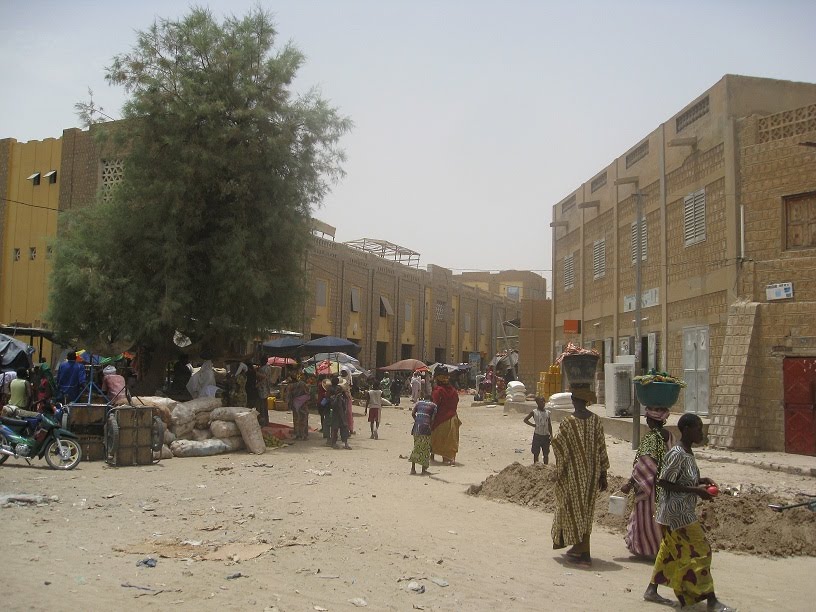
So, what’s it like then? First of all Timbuktu’s big in the sense that it sprawls over a wide area but there’s no discernible centre so you wander randomly through streets which are entirely under sand from the surrounding desert seeing the same shabby one and two-storey buildings throughout. There’s a palpable air of disinterest and apathy throughout though it’s probably the heat which, by midday, is insufferable for all. There’s a sign in the city which says (in French) ‘Welcome to Timbuktu, city of the 333 saints’ - to be sure, a number picked to give Irish people everywhere a difficult time of it. The other side of that is that I think that you’d have to be a saint to even consider living here which is why the number is so disproportionately high. Probably. I’m trying to think of something interesting to say about Timbuktu, damn it I’m trying to make things up about Timbuktu but it’s beyond me. If you ever happen to be in Mali and think ’Wow, Timbuktu, I’ll have to check that out.’ Don’t bother. I meet one other tourist here whose lifetime ambition it was to visit Timbuktu but he has that haunted look of a man who’s thinking ‘This can’t be it’. Be careful what you wish for.
Eating here is certainly a novel experience. Word is that there’s a secret spice used in all dishes served here in Timbuktu which certainly adds a bit of bite to your dish - it’s called sand. It’s in every single meal that I eat so it’s just a case of grit and bear it. If you learn nothing else from this post then at least you’ll know how Timbuktu got its name (if you already know this you have my respect and my pity - clearly you need to get out more). The city was originally established as a temporary encampment for nomadic Tuaregs and an old woman called Boctou was put in charge of it. Boctou means ‘large navel’ and the ‘Tim’ part simply means ‘well’ and when you put the two together you have ‘Timboctou’ which is ‘the well of the woman with the large navel’. The official local spelling is ‘Tomboctou’ which further complicates things but that’s the history. How big can a navel be?